What is collision insurance?
Collision coverage pays to repair your own car after a crash you caused, or one with no other vehicle involved. When another driver is at fault, a different coverage pays.
 Eldho George, RIBOEldho George, RIBOHead of PolicyScanner, Licensed Insurance BrokerEldho George is a licensed insurance broker and the head of PolicyScanner. He writes PolicyScanner’s guides to help Ontario drivers understand what their auto insurance covers, what it costs, and what to ask before they buy.
Key takeaways
- Collision coverage pays for damage to your own car when you hit something, or tip over.
- If another driver is at fault, your car is repaired under a different coverage that every Ontario policy carries. Collision coverage is what pays when the fault is yours.
- With no other car involved — a ditch, a pole, a rollover — collision coverage is the only thing that pays.
- If the fault is split, so is your deductible. At 25% at fault you pay a quarter of it.
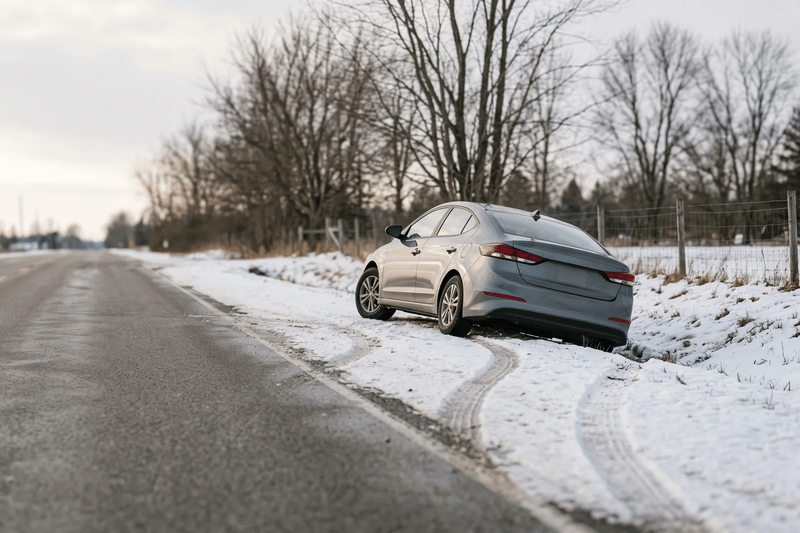
Collision insurance is the optional coverage that pays to repair or replace your own car after a crash, whether you hit another vehicle, a guardrail, a curb, or the ditch at the side of the road. It also covers a rollover, even if nothing else was involved.
Most people think of it as the coverage for when somebody else hits them, but in Ontario that is the other way around. If another driver is at fault, a different coverage pays for your car — and collision coverage is what pays when the fault is yours.
This guide covers what collision coverage pays for, when a different coverage pays instead, how the deductible works when fault is split, and whether it is worth keeping on an older car.
What does collision insurance cover?

Your car hitting something, or tipping over. Your policy calls it collision or upset coverage, and it will appear under that name on your certificate.
The policy is broader than most people assume about what counts as “something”. It names another vehicle, the surface of the ground, and any object in or on the ground. So:
- Another car, moving or parked
- A curb, a pole, a fence, a garage door
- A snowbank, or the ditch beside the road
- The ground itself, if you leave the road
- A rollover, even with nothing else involved
That last one is unusual and worth knowing if you drive a taller vehicle. Tipping over needs no impact at all.
What it does not cover is damage that arrives without a crash. Hail, fire, theft, a branch through the windscreen — those belong to comprehensive coverage.
It is also not the coverage that pays for the other driver’s car — that is third party liability, which every Ontario policy must carry by law. The difference is worth holding onto, because it is the one people get wrong most often. Liability pays for their car. Collision coverage pays for yours.
When collision coverage is the one that pays

In Ontario, when another car damages yours, your own insurer pays for the repair — not theirs. Every Ontario policy already includes that. It is called Direct Compensation, or DCPD.
But DCPD pays only in proportion to how little of the accident was your fault, so at 25% yours it covers 75% of the repair and at 100% yours it covers none of it.
And it pays nothing at all unless another insured car was in the accident.
The law is specific: at least one other automobile in the accident has to be insured in Ontario. It is also why you claim from your own company rather than chasing the other driver’s insurer.
So with no other car involved, these are entirely on you:
- You skid on ice and end up in a ditch
- You catch a post in a car park
- You clip a curb hard enough to bend a wheel
- Your car rolls over
- You hit an animal-sized pothole and the suspension goes
- A driver hits you and leaves — if they are never identified there is no insurer to claim from either
In every one of those, collision coverage is the only thing that pays.
So a car with DCPD and no collision coverage is covered for the crashes somebody else causes. For the ones you cause, and the ones nobody causes, it is not covered at all.
That gap is the reason to carry it, and a quote will not point it out to you.
Collision or comprehensive — which one pays?
The short version: collision coverage is for what the car hits. Comprehensive coverage is for what happens to it the rest of the time.
| What happened | Which one |
|---|---|
| You slid into a guardrail | Collision |
| A tree fell on the car | Comprehensive |
| You backed into a post | Collision |
| It was stolen | Comprehensive |
| You hit a deer | Comprehensive |
| You swerved to miss the deer and hit a fence | Collision |
| The car rolled over | Collision |
| Hail dented the roof | Comprehensive |
They are bought separately and each carries its own deductible. Ontario also sells them together as all perils coverage, and there is a cheaper option called specified perils. Which of the four suits you is worth one conversation before renewal.
How the collision deductible works
The deductible is the part you pay. Your insurer covers the rest, and the amount is set on your certificate.
The Ontario part is that your deductible is reduced in proportion to your degree of fault. If you are 25% at fault, you pay 25% of the deductible, not all of it. The policy sets it out in as many words: the deductible is multiplied by the percentage to which you were at fault.
| Your share of fault | What you pay of a $500 deductible |
|---|---|
| 0% | nothing |
| 25% | $125 |
| 50% | $250 |
| 100% | $500 |
If an adjuster asks for the full amount on a partial-fault claim, the arithmetic is wrong and it is worth saying so.
Fault is not decided by whoever argues hardest. Ontario publishes a set of rules that gives each kind of accident a fixed share of the blame, and every insurer has to apply them the same way. Your adjuster looks up the situation rather than forming a view of it.
There are only five answers available: 0%, 25%, 50%, 75% or 100%.
A few of them surprise people. Rear-ending another car is 100% the rear driver, even when the car in front was turning into a driveway. A door opened into traffic, a U-turn, or backing up is 100% the driver doing it.

Rear-ended: 100% to the rear driver. A lane-change sideswipe: 100% to the driver changing lanes. Backing up: 100% to the driver reversing. Pulling out of a parking space without yielding: 100% to the driver pulling out. Two drivers both ignoring a stop sign: 50/50.
One part of the rules surprises almost everybody. Fault is decided without regard to the weather, the road, how far you could see, or where the other car struck yours.
Black ice does not change the percentage. Nor does a blind corner, or the fact that they hit your back door rather than your front wing.
Fault is not decided by whoever argues hardest. It is looked up.
If you think the percentage is wrong, say so to your insurer first — the rules are published, so you can point at the one being applied. The law also lets you take your own insurer to court over it, which is worth knowing because the percentage decides how much of the deductible you pay.
Do you need collision coverage?
One question decides it. If the car were written off tomorrow and nobody else was liable, could you replace it without the money hurting?
If you couldn’t, keep it. Replacing the car is exactly what the coverage is for.
If you could, work out what the coverage can actually pay you. Take what the car is worth today and subtract your deductible — that is the ceiling. A $4,000 car with a $1,000 deductible is $3,000 of protection, and you pay a premium every month to keep it.
Two things override that:
- A financed or leased car. The lender decides, not you.
- What it is for. Most collision claims are at-fault claims, which is exactly the situation where nothing else pays.
One thing worth knowing before you claim. Ontario stops your insurer rating you on a genuinely minor accident — meaning it cannot put your premium up over it. But the protection has a condition most people miss: it only holds if nobody claims. Damage under $5,000, paid by the at-fault driver, no injuries, and no insurer payment at all. The moment your insurer pays a dollar, it becomes an ordinary at-fault claim.
That threshold was $2,000 until 2025. Plenty of advice online still quotes the old figure, so check the date on anything you read about it.
If the car is written off
The payout is not what you paid for the car, and not what you still owe on it.

Actual cash value is the term, and it means what the car was worth on the day it was lost, with depreciation taken off. Your deductible comes off that.
Ontario sets out when a car must be written off rather than repaired. The test is the repair cost against what the car was worth, less its salvage value — what the wreck is worth to a scrapyard. It is a formula rather than a percentage, which is why the familiar “70% of value” rule of thumb roughly works without being the actual rule.
If you disagree with the number, you do not have to accept it. You appoint an appraiser to value the car, your insurer appoints one, and if the two cannot agree an umpire decides. That decision is final. It settles the value only — anything about whether you are covered goes to court instead.
Compare quotes from 15+ insurers.
With a licensed Ontario broker on your side, at no extra cost.
Sources
- Insurance Act, R.S.O. 1990, c. I.8, s. 263 — Direct Compensation (opens in new tab)
- Ontario Automobile Policy (OAP 1) §7.1.2 C, §7.3 — collision or upset
- O. Reg. 668 — Fault Determination Rules (opens in new tab)
- O. Reg. 664 s. 5(2.1)-(2.3) — minor accident, $5,000 threshold
Related guides
About the author
Eldho George, RIBO
Eldho George is a licensed insurance broker and the head of PolicyScanner. He writes PolicyScanner’s guides to help Ontario drivers understand what their auto insurance covers, what it costs, and what to ask before they buy.
View profile and RIBO registration →